XRNest - XR Presentation Google Slides: Redefining Digital Storytelling
The landscape of professional communication is undergoing a seismic shift. As we move deeper into the digital age, traditional static slides are increasingly failing to capture the attention of audiences accustomed to immersive digital experiences. The rise of Extended Reality (XR)—encompassing Virtual Reality (VR), Augmented Reality (AR), and Mixed Reality (MR)—has not only transformed how we interact with technology but also how we visualize complex data and narratives. In this evolving ecosystem, XRNest - XR Presentation Google Slides emerges as a pivotal tool for professionals seeking to bridge the gap between conventional slide decks and futuristic visual storytelling.
This template is not merely a collection of pre-designed layouts; it represents a strategic approach to presenting ideas in an era where visual engagement dictates success. By integrating sleek aesthetics with functional design principles tailored for the XR domain, XRNest empowers users to craft presentations that resonate with modern sensibilities. Whether you are a business executive pitching a new venture, an educator explaining complex scientific concepts, or a creative director showcasing a portfolio, the ability to present your work within a context that feels native to the future is invaluable.
The Evolution of Presentation Design in the XR Era
To understand the significance of tools like XRNest, one must first appreciate the trajectory of presentation design. For decades, the standard was a white background with bullet points and static images. While effective for information transfer, this format often lacked emotional resonance and failed to demonstrate the depth of immersive technologies. As companies began adopting XR solutions, they faced a paradox: how do you explain a 3D, interactive experience using a 2D, linear medium?
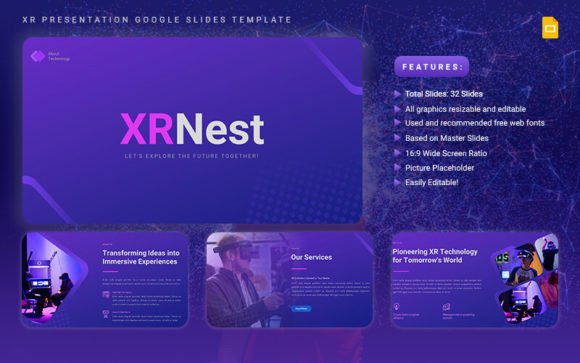
XRNest - XR Presentation Google Slides Template addresses this paradox by adopting a design language that mirrors the environments it describes. The aesthetic choices inherent in the template—dark modes, neon accents, spatial layouts, and dynamic typography—are not arbitrary. They are derived from the visual grammar of virtual worlds. When an audience sees a slide that visually echoes the interface of a VR headset or the overlay of an AR application, the cognitive load required to understand the concept decreases significantly. The presentation itself becomes a microcosm of the technology being discussed.
This alignment between form and function is crucial for establishing credibility. When a presenter discusses groundbreaking XR projects using a dated, generic template, there is an immediate dissonance. Conversely, utilizing a specialized framework like XRNest signals expertise and forward-thinking. It tells the audience that the presenter understands the nuances of the industry and has taken the time to curate an experience that matches the sophistication of their content.
Bridging the Gap Between Concept and Visualization
One of the most significant challenges in the XR sector is visualization. Describing a virtual environment through text alone is often insufficient. XRNest provides a canvas specifically designed to highlight these elements. The template includes dedicated picture placeholders and layout structures that accommodate high-resolution renders, 360-degree video thumbnails, and augmented reality overlays without cluttering the screen.
Consider a scenario where a researcher needs to present findings on user behavior within a simulated training environment. Using a standard template might force them to shrink critical diagrams or bury key metrics in dense text. With XRNest, the wide-screen ratio and customizable master slides allow for expansive visual displays. The researcher can place a large, immersive screenshot of the simulation alongside concise, impactful data points, creating a narrative flow that guides the viewer through the experience rather than just listing facts about it.
Furthermore, the inclusion of dynamic animations within the template adds a layer of temporal engagement. In XR, movement and interaction are key. Static slides can feel jarring when discussing fluid digital spaces. The subtle transitions and motion effects available in XRNest mimic the smoothness of a well-optimized virtual world, keeping the audience engaged and reinforcing the message of innovation.
Practical Applications Across Industries
The versatility of XRNest - XR Presentation Google Slides extends far beyond tech startups. Its design philosophy makes it applicable across a broad spectrum of industries where clarity and impact are paramount.
- Corporate Strategy and Pitching: Investors and stakeholders are bombarded with proposals daily. A pitch deck that stands out visually can make the difference between securing funding and being overlooked. For businesses entering the metaverse or developing AR marketing campaigns, XRNest offers a professional yet cutting-edge look that aligns with investor expectations for growth and innovation.
- Educational Institutions: Educators teaching subjects related to computer science, engineering, or digital arts need tools that inspire students. Using a template that reflects the real-world tools students will use helps demystify complex topics. It transforms a lecture into an engaging session that feels relevant to current industry standards.
- Creative Agencies and Portfolios: Designers and architects often struggle to showcase their work in a way that does justice to the final product. XRNest allows creatives to frame their work within a context that highlights its immersive potential. The customizable graphics and resizable elements ensure that every project image is presented at its best.
- Healthcare and Training: Medical professionals using VR for surgical training or patient therapy need to communicate the efficacy of these programs to hospital boards. The clean, modern lines of the XRNest template help present clinical data and simulation results with the seriousness and precision required in healthcare settings.
In each of these scenarios, the underlying goal is the same: to reduce friction in communication. By providing a structure that anticipates the needs of XR-related content, the template removes the burden of design from the presenter, allowing them to focus entirely on the substance of their message.
Technical Flexibility and Workflow Integration
A common concern when adopting specialized templates is the fear of losing flexibility. Users often worry that a highly stylized theme will be difficult to customize or incompatible with their existing workflows. XRNest - XR Presentation Google Slides is engineered to avoid these pitfalls, prioritizing ease of use without sacrificing design integrity.
The template is built upon a robust Master Slide system. This architecture ensures that global changes—such as updating a font style, adjusting color schemes, or repositioning logos—can be applied instantly across all 32 included slides. This feature is particularly valuable for teams working on collaborative projects where brand consistency is non-negotiable. Instead of manually editing dozens of individual slides, a team lead can modify the master layout, and the entire deck updates automatically.
Moreover, the compatibility of the files is a significant advantage. The package includes both a Google Slides version and a .PPTX file, ensuring seamless integration whether the organization relies on cloud-based collaboration or desktop software. This dual-format support eliminates technical barriers, allowing users to choose their preferred environment while maintaining access to the full suite of features.
Customization is further enhanced by the use of recommended free web fonts. These fonts are selected not only for their aesthetic appeal but also for their readability across different devices and platforms. Since the graphics are fully editable and resizable, users can adapt icons, shapes, and backgrounds to fit specific branding guidelines. This level of control ensures that the final presentation feels bespoke rather than templated.
Optimizing for Wide-Screen Displays
The shift toward larger screens and cinematic viewing experiences has made the 16:9 wide-screen ratio the industry standard. XRNest embraces this format fully, designing layouts that utilize the horizontal space effectively. Unlike older 4:3 templates that often leave awkward empty margins on modern monitors, XRNest fills the frame with purposeful content.
This wide aspect ratio is particularly beneficial for showcasing panoramic images, which are common in VR development. It allows side-by-side comparisons of different virtual environments or before-and-after shots of AR implementations without compromising image quality. The thoughtful arrangement of picture placeholders ensures that visual assets remain the focal point, drawing the audience's eye exactly where the presenter intends.
Strategic Considerations for Implementation
While the technical capabilities of XRNest are impressive, successful implementation requires a strategic approach. Simply applying the template is not enough; the content must align with the visual language to create a cohesive narrative.
First, consider the balance between visual flair and information density. The immersive nature of the design invites creativity, but it is essential to maintain clarity. Use the dynamic animations to guide the flow of information, not to distract from it. Each transition should serve a purpose, such as revealing a data point or shifting focus to a new section of the argument.
Second, leverage the documentation provided with the template. Understanding the specific functions of the master slides and the logic behind the layout choices can significantly speed up the creation process. The documentation acts as a guide, helping users navigate the advanced features and unlock the full potential of the 32-slide suite.
Finally, remember that the images used in the demo are placeholders. The true power of XRNest lies in replacing these with high-quality, relevant visuals that tell your unique story. Whether it is a screenshot of a proprietary software interface, a photograph of a physical prototype, or a render of a future cityscape, the template is designed to elevate these assets, making them pop against the sophisticated background.
Conclusion: Embracing the Future of Communication
The transition to an XR-centric world is inevitable, and the tools we use to communicate our ideas must evolve accordingly. XRNest - XR Presentation Google Slides represents more than just a design upgrade; it is a strategic asset for anyone looking to communicate complex, innovative concepts in a compelling way. By combining technical flexibility with a forward-thinking aesthetic, it empowers professionals to stand out in a crowded marketplace.
Whether you are defining the next generation of virtual workplaces, educating the next wave of digital natives, or pitching the future of your business, the right visual foundation is essential. XRNest provides that foundation, offering a seamless blend of reality and digital elements that captivates audiences and leaves a lasting impression. In an age where attention is the most valuable currency, investing in a presentation tool that respects the intelligence and expectations of your audience is not just an option—it is a necessity.