Retro Faun Playing Saxophone Mascot: A Practical Evaluation for Brand Identity
In the crowded landscape of digital branding, establishing a memorable visual identity often requires more than just a clean geometric logo. Many businesses find that character-based mascots offer a unique emotional connection with their audience. The Retro Faun Playing Saxophone Mascot represents a specific niche within this category, blending mythological elements with a distinct musical aesthetic. This design is not merely an image; it is a comprehensive branding asset designed to provide flexibility and professional polish. For entrepreneurs, creative directors, and small business owners evaluating their options, understanding the practical utility of such a resource is essential before committing to a purchase or integration.
This article examines the characteristics of the Retro Faun Playing Saxophone Mascot, compares its format and utility against standard alternatives, and outlines the scenarios where this specific style offers the most value. By analyzing the technical specifications and creative potential, readers can determine if this mascot aligns with their strategic goals or if a different approach might be more suitable.
Defining the Aesthetic and Functional Value
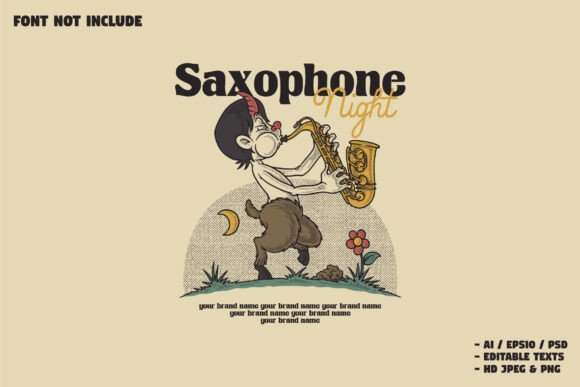
The core appeal of the Retro Faun Playing Saxophone Mascot lies in its fusion of vintage nostalgia and lively character design. A faun, a creature from Roman mythology associated with nature and music, naturally evokes themes of creativity, freedom, and organic growth. When depicted playing a saxophone, the imagery shifts toward rhythm, soul, and performance arts. This combination creates a versatile symbol that can serve industries ranging from jazz clubs and music festivals to creative agencies and lifestyle brands seeking a "retro-cool" vibe.
Unlike static logos that rely on typography alone, a mascot illustration provides a narrative hook. It allows a brand to personify its values. The retro styling—often characterized by bold lines, warm color palettes, and a slightly grainy texture—resonates well with audiences aged 20 to 50 who appreciate vintage aesthetics without sacrificing modern clarity. This specific design distinguishes itself through its high level of detail while maintaining the structural integrity required for various applications.
Functionally, the asset is delivered as a complete package rather than a single image file. It includes fully editable vector files compatible with Adobe Illustrator (AI), layered raster files for Photoshop (PSD), and universal EPS formats. This multi-format delivery is a critical factor for professionals who need to adapt the design across different media, from large-scale outdoor banners to tiny social media avatars.
Comparing Formats: Vector vs. Raster Assets
When evaluating branding resources, the file format is often the deciding factor between a one-time use graphic and a scalable brand asset. The Retro Faun Playing Saxophone Mascot is primarily a vector-based solution, which offers significant advantages over standard raster-only images found in many stock libraries.
- Scalability: Vector files (AI, EPS) are mathematically defined, meaning the Retro Faun Playing Saxophone Mascot can be resized infinitely without losing resolution. Whether printed on a billboard or a business card, the edges remain crisp. In contrast, raster images (like JPG or PNG) pixelate when enlarged beyond their original dimensions.
- Editability: The inclusion of organized layers in the AI and PSD files allows for deep customization. Users can isolate specific elements—such as the saxophone, the faun's expression, or the background colors—and modify them independently. Standard stock photos or flattened PNGs do not offer this level of control.
- Resolution Quality: The provided raster version boasts a resolution of 4000x4000px at 300 DPI. This ensures that even if a user chooses to work within a raster environment like Photoshop for texturing or effects, the output remains print-ready and vibrant.
However, there are tradeoffs. Working with complex vector illustrations requires familiarity with design software. A user looking for a drag-and-drop solution in a basic presentation tool might find the raw vector files challenging to manipulate without some training. In such cases, a pre-rendered PNG might be simpler, though it sacrifices long-term flexibility.
Evaluating Customization and Adaptation
One of the primary strengths of the Retro Faun Playing Saxophone Mascot is its capacity for adaptation. Branding is rarely a "one size fits all" endeavor. Companies often need to adjust a design to match existing color schemes or to create variations for different product lines.
The organized layer structure facilitates this process. For instance, a coffee shop might want to change the faun's instrument to a cup or alter the color palette to match their interior decor. Because the design is built with logical grouping, these changes can be made quickly without redrawing the entire character. This contrasts sharply with buying a generic clip-art icon where every element is merged into a single shape, making modification nearly impossible.
Nevertheless, customization has limits. While colors and text can be easily adjusted, fundamentally changing the pose or anatomy of the faun would require advanced illustration skills. If a brand needs a completely unique character from scratch, commissioning a custom illustrator might be a better investment than modifying a pre-made template. The Retro Faun is best suited for businesses that like the core concept but need to tailor the execution to fit their specific brand guidelines.
Best-Fit Scenarios and Use Cases
Determining whether the Retro Faun Playing Saxophone Mascot is the right choice depends heavily on the brand's industry and target demographic. This style excels in environments where personality and storytelling are paramount.
Ideal Applications:
- Musical Venues and Events: Jazz bars, concert promoters, and music schools can leverage the saxophone motif directly. The retro feel complements the history of jazz and blues perfectly.
- Creative Agencies: Marketing firms and design studios often use mascots to show they are approachable and innovative. The whimsical nature of a faun suggests out-of-the-box thinking.
- Lifestyle and Merchandise: Brands selling apparel, stickers, or home goods benefit from the detailed illustration, which translates well onto physical products. The high-resolution files ensure that prints on t-shirts or mugs look professional.
- App Icons and Web Graphics: The distinct silhouette of the faun makes it recognizable even at small sizes, serving as an effective favicon or app icon.
Less Suitable Scenarios:
Conversely, this mascot may not be the optimal choice for highly formal sectors such as law firms, medical institutions, or corporate finance. The playful and mythical nature of a faun could undermine the seriousness required in these fields. Similarly, brands aiming for a minimalist, ultra-modern "tech startup" aesthetic might find the detailed retro illustration too busy or nostalgic. In those cases, a simple typographic logo or abstract geometric mark would likely communicate the desired message more effectively.
Technical Considerations and Workflow Integration
From a technical standpoint, the delivery method of the Retro Faun Playing Saxophone Mascot is designed for efficiency. The files are compressed into a single ZIP archive, containing the AI, PSD, and EPS versions. This consolidation simplifies the download and organization process. Users will need standard extraction tools like WinRAR or WinZIP, or simply double-click the file on most operating systems to access the contents.
For teams working collaboratively, the layered PSD file is particularly valuable. It allows graphic designers to make quick adjustments without needing to open the heavy vector software. Meanwhile, the AI file serves as the master source for print production and major redesigns. This dual-approach workflow supports both rapid iteration and high-fidelity final output.
It is important to note that while the files are fully editable, they are not "smart objects" in the sense that they automatically adapt to new contexts. The responsibility for color correction, layout, and context placement falls on the user. Therefore, having at least a basic proficiency in Adobe Creative Cloud or similar design software is recommended to fully utilize the asset's potential.
Decision Factors for Potential Buyers
Before integrating the Retro Faun Playing Saxophone Mascot into a brand strategy, decision-makers should consider three key factors:
- Brand Alignment: Does the retro-musical theme genuinely reflect the company's voice? Forced associations can confuse customers. The mascot should feel like a natural extension of the brand story.
- Resource Availability: Does the team have the time and skill to customize the layers? If immediate deployment is needed without modification, the default colors and composition must already meet the brand's needs.
- Long-Term Versatility: Will this mascot age well? While retro styles cycle in popularity, the fundamental character design should remain relevant for years. The timeless quality of a faun combined with a classic instrument generally offers good longevity compared to trend-specific graphics.
Ultimately, the value of this asset lies in its balance between professional polish and creative flexibility. It bridges the gap between expensive custom illustration and rigid stock photography. For businesses ready to adopt a bold, character-driven identity, the Retro Faun Playing Saxophone Mascot provides a robust foundation. However, for those requiring extreme minimalism or hyper-realistic imagery, exploring other categories of design resources may yield better results. By carefully weighing these factors, organizations can make an informed decision that supports their long-term branding objectives.